
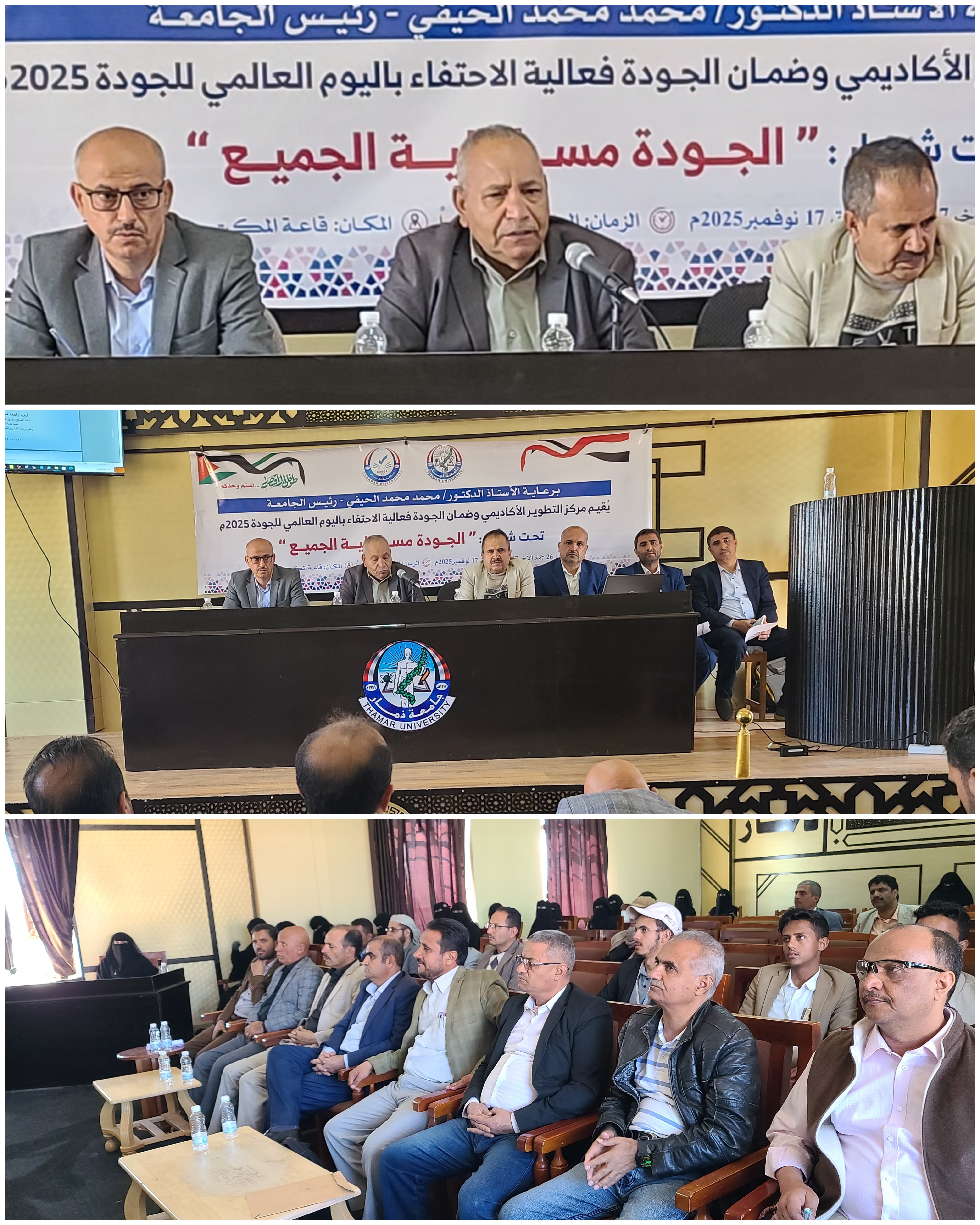
Thamar University Commemorates World Quality Day 2025 with an Event Promoting a Culture of Quality in the University Environment
□ Thamar University Media / Jamal Al-Bahri / Jumad Al-Awwal 26, 1447. November 17, 2025
■ This morning, the Martyr Al-Ghumari Hall hosted a distinguished academic event organized by the Center for Academic Development and Quality Assurance, under the patronage of Professor Dr. Mohammed Mohammed Hassan Al-Haifi, the Rector of the University, to celebrate World Quality Day 2025.
The event was attended by Professor Dr. Abdulkafi Al-Rifai, Vice-Rector for Student Affairs, Dr. Abdulghani Al-Ansi, the Vice-Rector for Academic Affairs and Dean of the Center for Academic Development and Quality Assurance; Dr. Mohammed Hutram, the General Secretary General of the University, and a number of academic and administrative leaders.
This year's event was held under the slogan "Quality is Everyone's Responsibility," reflecting the university's vision of strengthening the role of quality as an integrated institutional approach that contributes to developing the university learning environment and supports efforts to raise academic accreditation standards and institutional performance indicators.
The event commenced with a recitation from the Holy Quran, followed by an opening address from Professor Dr. Mohammed Mohammed Hassan Al-Haifi. In his remarks, Professor Dr. Al-Haifi emphasized the strategic importance of the university's commitment to quality standards and assurance.
He noted that quality has become a cornerstone of institutional work in modern universities and a primary means of achieving advanced levels of efficiency, accreditation and effectiveness. He also pointed out that Thamar University has made significant strides in enhancing all its academic programs and a number of its administrative functions and activities.
The event comprised three main themes. The first theme, presented by Professor Dr. Adel Abdulghani Al-Ansi, reviewed several advanced international experiences in developing higher education institutions. He explained how these experiences could be applied in Yemeni universities to create a learning environment more responsive to academic changes.
In this context and within the second session, Dr. Abdulkarim Mohammed Al-Mawshki presented an analytical overview of the university's academic programs during the 2024-2025 academic year (1446), highlighting the advantages gained by programs that met the requirements for academic accreditation and the role this played in enhancing the quality of educational outcomes.
In the third session, Dr. Ahmed Mosaad Al-Hadi addressed the concept of "Quality is a Shared Responsibility," emphasizing the importance of collaborative work between academic and administrative units in fostering a culture of quality within the university and the necessity of establishing the principles of continuous improvement as an integral part of the institutional framework.
The event, moderated by Nasser Najad, the General Secretary of the Academic Development Center, concluded with a comprehensive presentation of recommendations and proposals by Dr. Ahmed Saleh Al-Farasi.
These included an emphasis on continuing the implementation of qualification and training programs, supporting the integration of roles between colleges and the center, expanding efforts aimed at raising the level of academic and administrative performance and reinforcing academic accreditation pathways in accordance with national and international standards.
The event, which was also attended by several university leaders, including the Dean of the Faculty of Arts and several faculty members, the Head of the Library Department and several staff members from the university's central library, the Vice Deans of the Continuing Education Institute, the General Assistant Secretary for Human Resources, the Head of the Media and Public Relations Department, the Head of the Documentation Unit at the Center, and a number of academic and administrative leaders and quality assurance officials, focused on reaffirming Thamar University's commitment to developing its academic work mechanisms and consolidating its quality system to achieve its strategic goals and enhance its standing as a scientific institution striving to provide high-quality education that embodies the principles of excellence and continuous improvement.