Thamar University Charts a New National Awareness Map Through Its First Scientific Conference on Combating Addiction
□ Thamar University Media / Jamal Al-Bahri / Jumada Al-Awwal 28 1447, November 19, 2025
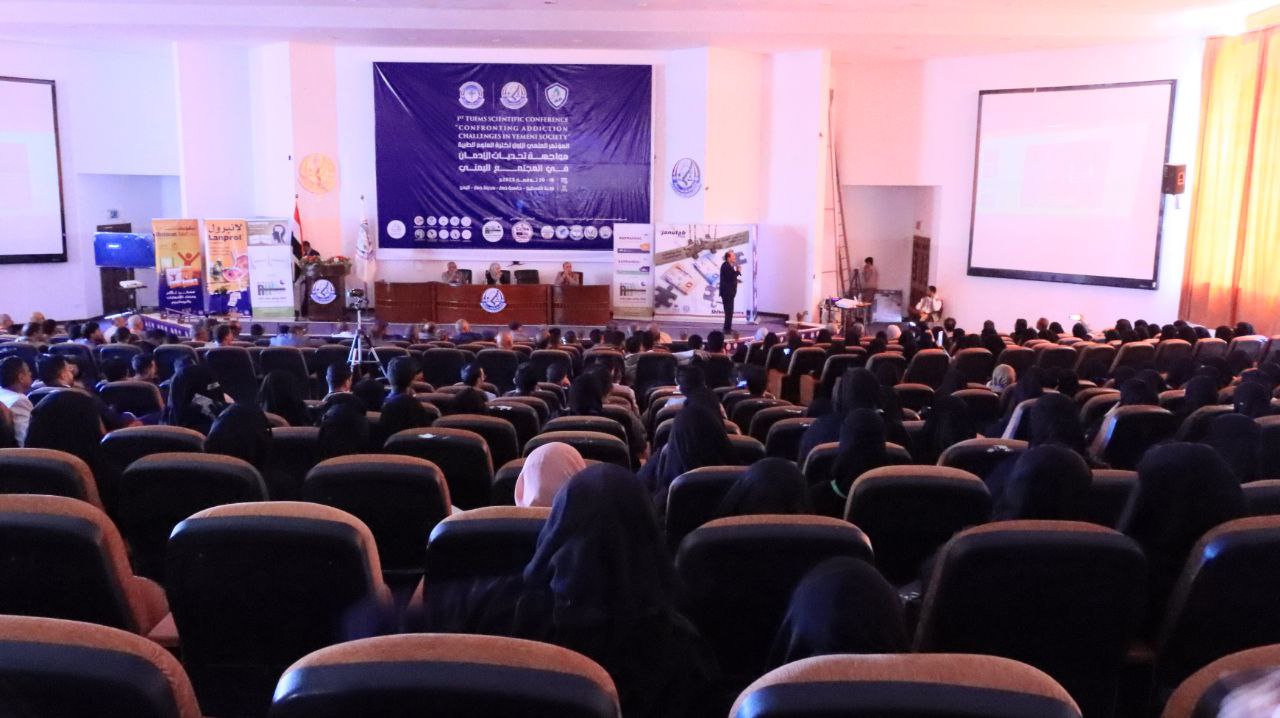
■ The first scientific conference was held under the patronage of Professor Dr. Mohammed Mohammed Hassan Al-Haifi, the Rector of Thamar University and the Chairman of the Supervisory Committee.
It was attended by state and community leaders, as well as a select group of scientists and physicians, to address the challenges of addiction at Thamar University and present society with a comprehensive national vision that restores the importance of science as the first line of defense in the battle for awareness.
From its opening, the conference emphasized that its ultimate goal is to enhance community awareness and provide scientific and practical solutions capable of addressing the phenomenon of addiction, which has become an escalating threat to youth, families, and society.
The conference proceedings stemmed from a firm conviction that confronting this scourge cannot be achieved without genuine cooperation between health, educational, media, and awareness institutions, in addition to the vital role played by families in protecting their children.
These efforts were undertaken under the umbrella of a national vision that seeks to establish a new era of social cohesion and address the damage caused by addiction.
In the scientific sessions, the lectures were divided into several complementary tracks. Researchers addressed digital addiction and its health repercussions in an age where technology has accelerated, creating a new pattern of compulsive behaviors. They then turned to the brain and its secrets in confronting this danger, emphasizing how drugs reshape the nervous system and alter its vital pathways.
One paper focused on the impact of addiction on the family and society, pointing out that the danger threatens not only the individual but also strikes at the very heart of social bonds.
From scientific critique to the cardiovascular aspect, cardiologists discussed the repercussions of addiction on the heart and blood vessels, revealing shocking facts about the effects of drugs on the heart muscle and the circulatory system.
Because khat is an integral part of Yemeni social behavior, the conference dedicated significant time to discussing the psychological and neurological aspects of chewing it. Other lectures addressed the problems of addiction during pregnancy and the long-term risks it poses to the fetus before birth.
The legal aspect was also strongly present, with specialists discussing the level of public awareness in light of Yemeni legislation and how the law can contribute to protecting youth and deterring drug dealers. Sessions also touched upon addiction to medications and chemicals, particularly in light of the misuse of certain drugs, as well as traditional and electronic smoking, which has become one of the most widespread forms of addiction among young people.
With this rich diversity, the conference presented a balanced intellectual journey, moving from technology and neuroscience to family and law and encompassing the heart, mind, and behavior. Participants agreed that this scientific movement represents a foundational step towards a new phase of institutional work that goes beyond simply diagnosing the phenomenon, striving instead to build a conscious society capable of protecting its youth and improving their health and future.
The conference was attended by members of the Higher Supervisory Committee, Professor Dr. Abdulkafi Al-Rifai, the Vice-Rector for Student Affairs, Professor Abdulkarim Zabiba, the Vice-Rector for Graduate Studies and Scientific Research, Professor Adel Abdulghani Al-Ansi, the Vice-Rector for Academic Affairs, and Dr. Mohammed Hutram, the General Secretary of the University.