2026-09-13
Academic Elite at Thamar University Revives the Voice of Al-Bardouni in a Symposium on “A Poem That Transcends Time”
□ Thamar University Media / Jamal Al-Bahri / Rabi Al-Thani 2, 1448. September 13, 2026
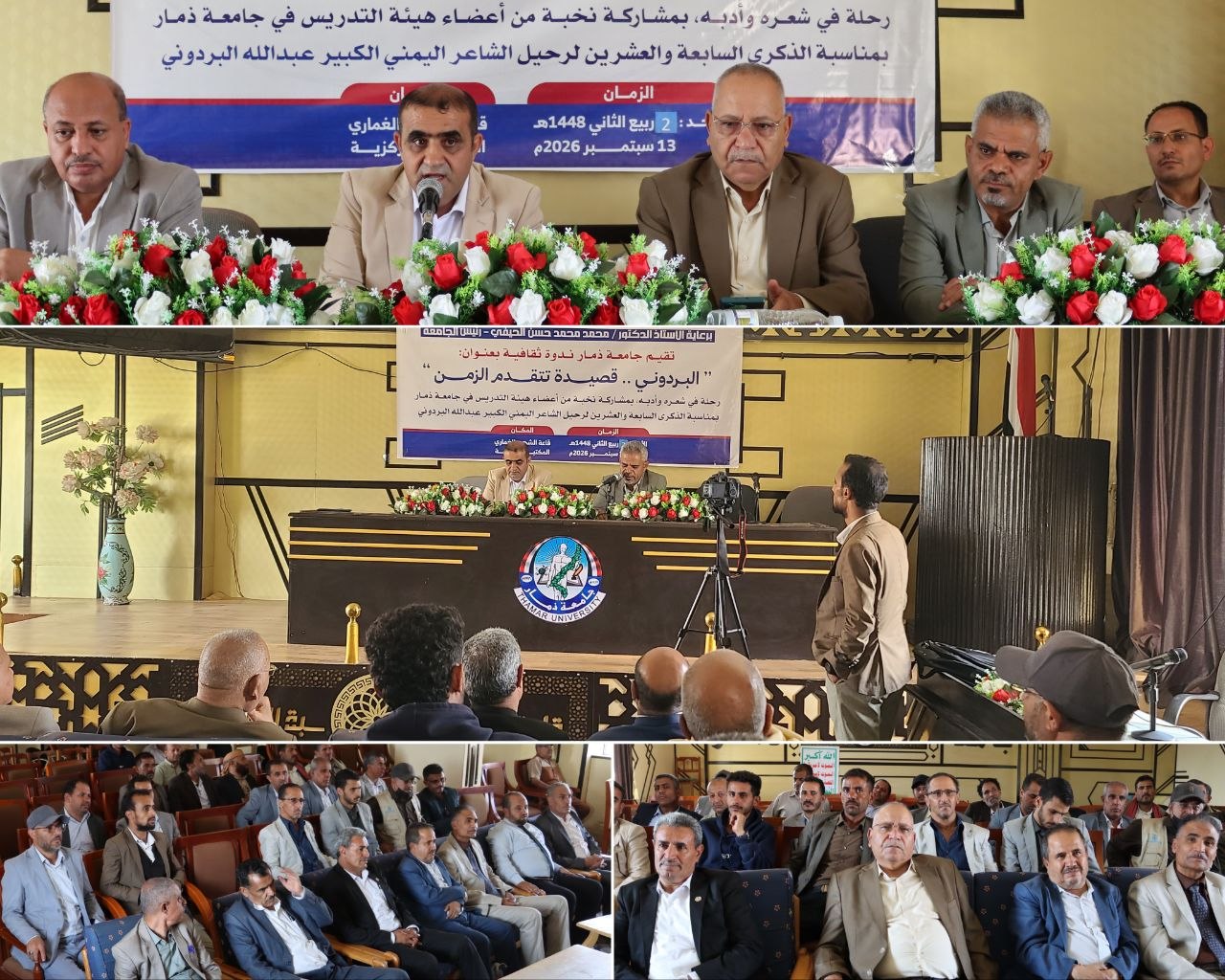
■ From the Martyr Al-Ghumari Hall at Thamar University, in the governorate that gave birth to Al-Bardouni, from whose villages he took his name, a name that became a landmark in the landscape of Arabic poetry, Thamar University today revived the voice of the great Yemeni poet Abdullah Al-Bardouni in a cultural symposium entitled “Al-Bardoun, A Poem That Transcends Time.”
The symposium was held under the patronage of Professor Dr. Mohammed Mohammed Hassan Al-Haifi, the Rector of the University, and with the participation of a number of faculty members and those interested in literature and thought, on the twenty-seventh anniversary of the poet's passing.
The symposium, held in the Martyr Al-Ghumari Hall at the Central Library, began with verses from the Holy Quran, followed by the recitation of Al-Fatiha in remembrance of the nation's martyrs, and then the playing of the national anthem. This scene evoked Al-Bardouni's stature as a poet whose work was deeply intertwined with humanity, the homeland, and the questions of freedom, dignity, and sovereignty.
In his welcoming remarks, the University Rector Professor Dr. Mohammed Mohammed Hassan Al-Haifi recounted key moments in Al-Bardouni's life, highlighting his literary and intellectual significance and the exceptional presence of his poetry in Yemeni and Arab memory. He emphasized the importance of introducing his work to new generations, not merely as a literary relic of the past, but as a creative and intellectual experience that continues to engage with the present and address its challenges.
The symposium was moderated by the Assistant to the University Rector for Centers Affairs, Professor Dr. Essam Wasel, who guided its discussions, which ranged from an analysis of Al-Bardouni's poetic experience and an exploration of its intellectual and national dimensions to an examination of selected texts that addressed issues of humanity, the homeland, and the Arab nation.
In his paper, "Abdullah Al-Baradouni: A Study of Abu Tammam's Poem and Contemporary Arabism," Dr. Abdu Ghailan explored aspects of the poet's life and his intellectual and literary development. He traced al-Baradouni's upbringing in the village of Al-Baradoun in the Al-Hada'a district of Dhamar Governorate in 1929, his academic journey from Dhamar to Sana'a, his studies in Islamic law and linguistics, his early engagement with Arabic poetry, his graduation from Dar Al-Ulum in 1953, his work teaching Arabic literature, and his contributions to Yemeni cultural and broadcasting life.
During the symposium, Dr. Abdullah Asbah recited a poem titled "To Al-Baradouni in His Memory," evoking the image of the poet who made words a window onto the homeland and insight a path to transcend darkness. The poem highlighted Al-Baradouni's enduring presence in Yemeni memory as a poet whose legacy remains undiminished, his poetry forever connected to the questions of Yemen, history, and time.
Mr. Hassan Al-Mawshki presented a paper addressing aspects of Al-Bardouni's life and literary output, including his published and unpublished collections of poems and poetry. He also discussed Al-Bardouni's stances on national, pan-Arab, and regional issues, particularly the Palestinian cause, and his critical perspective on dependency and foreign domination.
Al-Mawshki focused on several of Al-Bardouni's poems that offered insightful perspectives on Yemeni and Arab reality, explaining that some of his texts, when read today, seem deeply connected to the questions and transformations of the present. This reinforces the symposium's assertion that Al-Bardouni's poetry transcends time, ensuring the poet's continued relevance whenever reality revisits the questions his work so often raised.
In a paper titled “Abdullah Al-Baradouni and Ansar Allah: Intersecting Visions on Colonialism, Hegemony, and Yemeni Sovereignty,” Associate Professor Dr. Aziz Ali Al-Aqra’ discussed the presence of colonialism, hegemony, dependency, and sovereignty in al-Baradouni’s poetry. He pointed out that Al-Baradouni’s vision of colonialism transcended the concept of direct military occupation, extending to political decision-making, awareness, culture, and ties to foreign interests.
Dr. Al-Aqra cited several of Al-Baradouni’s poems, including “The Invasion from Within” and “Abu Tammam and the Arabism of Today,” and compared some of these visions with contemporary political discourse on Yemeni sovereignty, resistance to foreign intervention, and support for the Palestinian cause.
The symposium was enriched by a number of interventions and discussions that broadened the perspectives on Al-Baradouni’s work. Among these were interventions by the Vice-Rector for Graduate Studies and Scientific Research, Professor Dr. Abdulkarim Zabiba, and the Vice-Rector for Academic Affairs, Professor Dr. Adel Abdulghani Al-Ansi, who addressed intellectual and literary aspects related to the symposium’s themes and al-Baradouni’s place in Yemeni culture.
The event concluded with a poem by Abdulmalik Al-Shukr, a student at Thamar University and winner of poetry competitions at the university and national levels across Yemen. In his poem, Al-Shukr expressed Al-Bardouni's literary and historical stature, evoking the richness of his poetic experience and his presence as a symbol of awareness, liberation, and resistance to oppression.
The symposium was attended by the University's General Secretary, several vice-Rectors, deans of faculties, department heads, directors-general, faculty members, and administrative staff, as well as a number of those interested in cultural and literary affairs. This vibrant cultural event brought Al-Bardouni back to his rightful place, where poetry is the memory of the nation, and where the poem can transcend time without losing its brilliance.