2026-06-27
Thamar University Hosts the Launch of the First National Education Forum in the Governorate Under the Slogan "Education is Everyone's Responsibility"
□ Thamar University Media / 12 Muharram 12, 1448. June 27, 2026
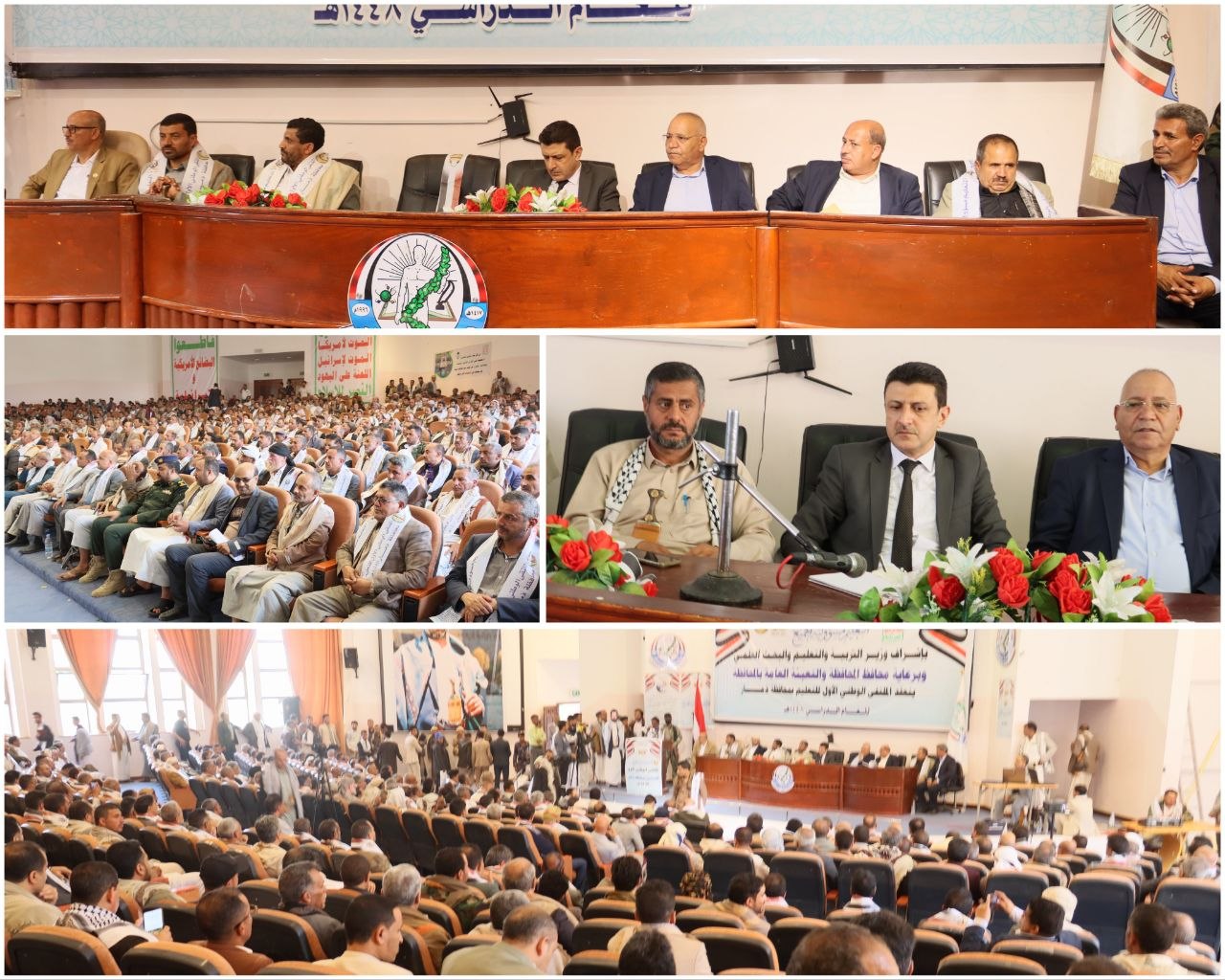
■ The Palestine Hall at Thamar University hosted today the activities of the first National Education Forum under the slogan "Education is Everyone's Responsibility," organized by the local authority and the General Mobilization Committee in Dhamar Governorate. The forum saw wide participation from state and local authority leaders, academic and educational leaders, social figures, philanthropists, and representatives of various community sectors. This unique event aimed to strengthen community partnerships to support the educational process and unify official and public efforts to advance the education sector and improve its outcomes.
At the opening of the forum, Professor Dr. Mohammed Mohammed Hassan Al-Haifi, the Rector of Thamar University and Chairman of the Higher Education Institutions Coordination Council in the governorate, welcomed the attendees and guests of the university. He emphasized that education is the cornerstone of nation-building and shaping the future, and that the responsibility towards it requires the concerted efforts of everyone institutions and individuals to confront the challenges facing its progress.
The University Rector reviewed a number of achievements and strategic initiatives undertaken by Thamar University in the past period. He noted that the university was among the first public universities to obtain academic accreditation and has worked to establish several specialized academic programs and postgraduate studies that meet the needs of society, development requirements, and the labor market.
He explained that the university continues to implement comprehensive development projects, including equipping laboratories and classrooms with modern facilities, opening new academic departments, and expanding solar energy projects. He also highlighted several qualitative additions aimed at improving the educational and research environment. Furthermore, he pointed to the pivotal role played by Thamar University within the Higher Education Institutions Coordination Council in the governorate and its efforts to enhance integration among universities and institutes to serve local development.
Professor Dr. Mohammed Al-Haifi addressed the opening of the College of Sharia and Law, highlighting its significant academic contribution to the university. He commended community initiatives supporting education, particularly the initiative of philanthropist Haj Mohammed Abdu Dadih, who funded, constructed, and equipped a modern classroom at the college with a capacity for 366 students. He emphasized that such initiatives exemplify a commendable model of community partnership in supporting education.
From his part, the Governor of Thamar Governorate and Head of the Local Council, Mohammed Nasser Al-Bukhaiti, reviewed the governorate's experience in developing education and modernizing its tools and methods. He stressed that the current stage necessitates the development of curricula and educational resources, as well as leveraging modern technologies and artificial intelligence to address educational challenges and raise the level of academic achievement.
The Governor explained that the governorate has implemented several high-quality projects in this area, including the establishment of a modern electronic library equipped with advanced educational resources, the production of audio-visual educational content, and the launch of electronic applications for course materials. These initiatives aim to facilitate students' access to knowledge and alleviate overcrowding in schools.
He pointed to the provision of smart screens in Dhamar city schools to display educational lessons interactively, emphasizing that the world is moving towards digital transformation and artificial intelligence, which necessitates keeping pace with these transformations and leveraging them to develop the educational process and improve its outcomes.
During his speech, Dr. Hatem Al-Duais, the Deputy Minister of Education and Scientific Research, in the presence of Professor Dr. Abdulkafi Al-Rifai, the Vice-Rector of Thamar University for Student Affairs, Professor Dr. Abdulkarim Zabiba, the Vice-Rector of the University for Graduate Studies and Scientific Research, Professor Dr. Adel Abdulghani Al-Ansi, the Vice-Rector of the University for Academic Affairs, Professor Dr. Essam Wasel, the Rector's Assistant to the University Rector for Centers Affairs, Hadi Ammar, the Undersecretary of the Ministry of Education and Scientific Research for the Basic Education Sector, Dr. Mohammed Hutrum, the General Secretary of the University, as well as deans and their deputies, and a number of academic and administrative leaders at the university, Dr. Al-Duais reviewed the Ministry's vision aimed at achieving comprehensive and sustainable quality education based on community partnership, which contributes to preparing a conscious and qualified generation capable of facing challenges and contributing to building the nation.
He emphasized that education is not the responsibility of any single entity, but rather a shared national and societal responsibility requiring the concerted efforts of everyone. He commended the innovative initiatives and pioneering experiences in Dhamar Governorate in supporting the educational process. He also expressed his appreciation to the local authorities, Thamar University, and all entities that contributed to the success of the forum, affirming the Ministry's support for all efforts aimed at developing education and improving its environment and outcomes.
Dr. Al-Du'ais praised the community initiatives launched by the governorate, including the establishment of a specialized workshop for manufacturing and maintaining school desks. He called for strengthening cooperation between educational institutions, the community, and the private sector to ensure the sustainability and development of the educational process.
From his part, Ahmed Hussein Al-Dhurani, the Public Mobilization Officer in Dhamar Governorate, affirmed that nations only advance through science and knowledge. He announced that the year 1448 would be the "Year of Education" in Dhamar Governorate, as a part of a comprehensive approach aimed at giving the education sector the highest priority in the coming phase.
Al-Dhurani praised the efforts made by Thamar University, the Education Office, and the Local Authority in supporting the educational process, commending the initiatives launched by merchants, philanthropists, and the people of the districts, villages, and rural areas to contribute to supporting schools and improving the educational environment, stressing that education will be at the forefront of development priorities in the governorate.
In the same context, the Director of the Education Sector in the governorate, Mohammed Hassan Al-Hadi, affirmed that the forum represents an important milestone for assessing the current state of education, identifying the challenges it faces, and reviewing practical initiatives and solutions to develop it. He also announced a package of initiatives supporting the educational process, including the manufacturing of 1,000 school desks, the provision of 88 new smart screens to supplement those previously distributed, and the allocation of five million riyals to each district to equip a model school, in addition to several initiatives being implemented by various executive offices and community organizations.
From his part, the Director of the Technical and Vocational Education and Training Sector in the governorate, Ahmed Al-Jarfi, addressed the importance of developing technical education and linking it to the needs of the labor market, as well as the necessity of creating specializations and programs that meet the requirements of economic development and provide broader opportunities for young people.
The Director of Statistics at the Governorate's Education Office, Nabil Al-Samhari, reviewed working papers and topics related to the state of education in the governorate, the achievements made in recent years, and the most prominent recommendations and proposals aimed at enhancing the sustainability of the educational process and improving performance indicators in the education sector.
The forum announced the launch of a package of official and community initiatives, along with contributions from philanthropists, for the 1448 academic year, aimed at supporting educational infrastructure. This included the construction of 28 schools comprising 130 classrooms and the renovation of 15 existing schools, totaling 77 classrooms. This represents significant support for the education sector, although these projects still cover only a limited portion of the actual needs for school infrastructure in the province.
At the conclusion of the forum, participants called upon business leaders, philanthropists, and community organizations to redouble their efforts in supporting education and contributing to the construction, equipping, and provision of essential school needs, recognizing education as the most important investment in the future of generations and the nation.
The event, attended by members of the House of Representatives and the Shura Council, the province's deputies, the head of the province's Court of Appeals, and a number of official and community leaders, included the honoring of a select group of supporters, philanthropists, and local, mobilization, and educational leaders in appreciation of their outstanding contributions and distinguished efforts in supporting education and enhancing the continuity of the educational process in the province.